
How Tradespeople Can Stay Safe When Shopping
This week has been a busy one for New Zealand, as we move through the Alert Level system of COVID-19 that was created by the New Zealand Government. As of…

Quick answer: The best time to send an invoice is when the job is done. Across 550,565 invoices sent by trade businesses on Fergus since January 2025, the share paid within seven days stayed between 31.0% and 33.4% in every send-time slot. The hour barely matters. How soon you send, and how easy it is to pay, matter much more.
You finish a job on Friday afternoon. The customer is happy and you are about to drive off.
Do you send the invoice now, wait until Monday morning, or hold it for the perfect time?
It feels like a small decision. Across hundreds of jobs, small delays put real pressure on cash flow. So we looked at the data to find the best time to send an invoice.
We reviewed 550,565 invoices sent by trade businesses on Fergus, the job management and invoicing software for tradies, since 1 January 2025. We grouped them by the day and hour each invoice was sent (for example, Wednesday 7pm), localised to each business’s time zone.
For each time slot, we compared:
No single hour stands out. Across the 40 time slots, the share of invoices paid within seven days ranged from 31.0% to 33.4%. That is a gap of just 2.4 percentage points between the best slot and the worst.
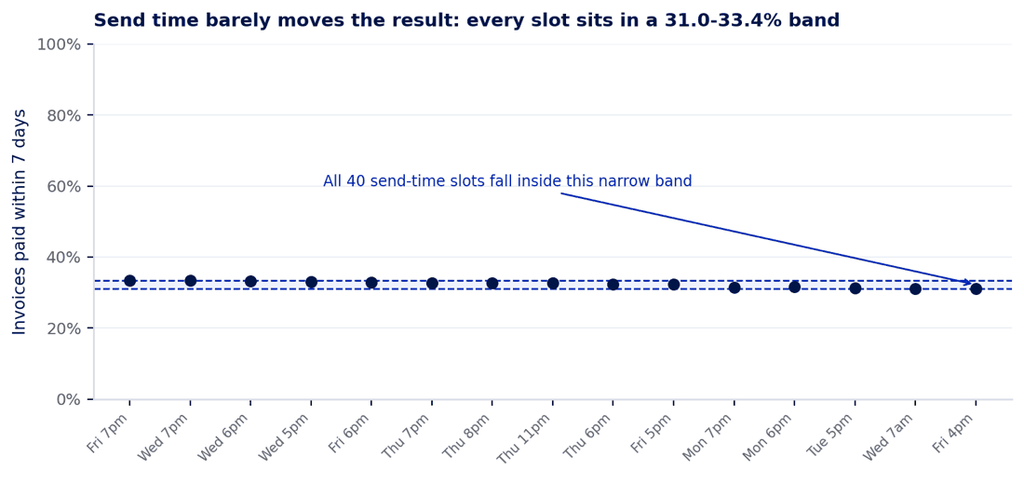
The stronger slots sat from Wednesday to Friday, late afternoon into the evening. That likely reflects how tradies already work: finish the job, pack up, then do the paperwork. The gap between morning and later slots was too small to justify holding a finished invoice for hours.
The winner also changes with the measure. The slots that led on seven-day payment were not the slots that led on payment within 48 hours, and the top results were too close to separate. So the data cannot crown one winning hour. A headline like “Friday at 7pm is the best time to invoice” would be catchy but misleading.
If a job finishes on Friday, send the invoice on Friday.
How soon you send makes a much bigger difference than the hour you send.
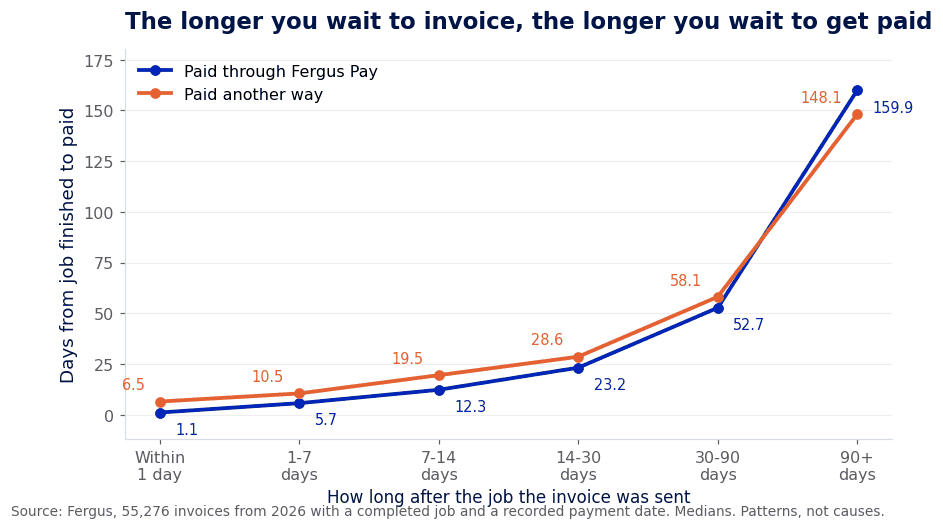
We looked at 55,276 invoices from 2026 that had a completed job and a recorded payment date. We compared how long each invoice took to go out with how long the job took to get paid.
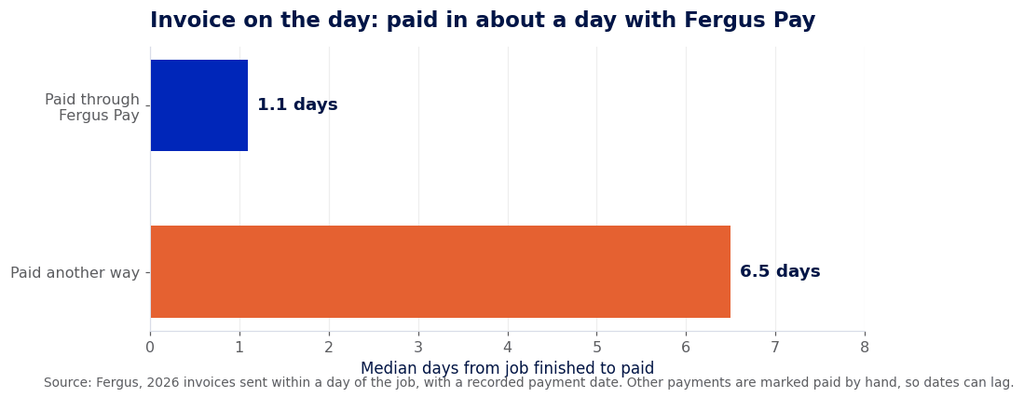
The longer you wait to invoice, the longer you wait for the money. Invoice within a day of finishing, and the job is usually paid in about a day through Fergus Pay, the online payment option built into Fergus invoices, or about a week paid another way. Wait 2-4 weeks to invoice, and the job takes almost 4 weeks to get paid. Wait 90 days or more, and it is about 5 months.
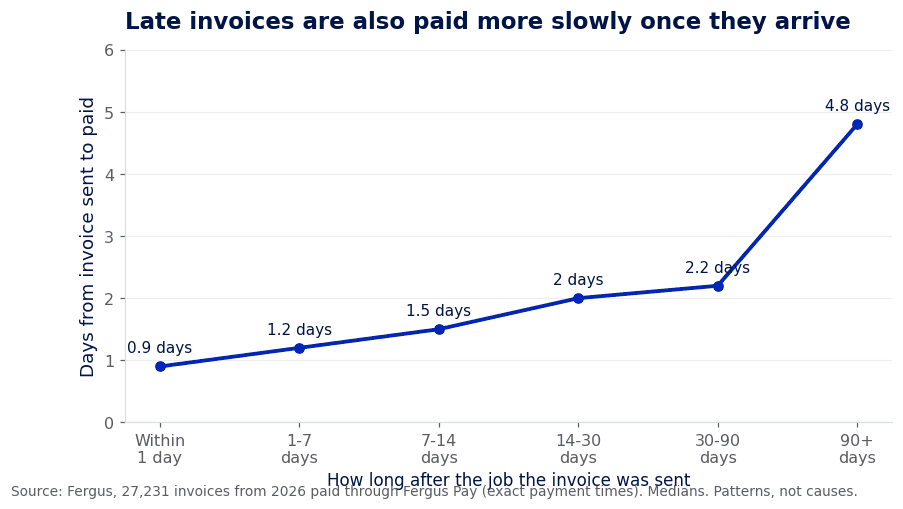
Late invoices are also slow a second time. With Fergus Pay, an invoice sent within a day of the job is paid in a median of 0.9 days once it arrives. Send it 90+ days late, and that wait rises to 4.8 days. So you wait to send, then you wait longer to get paid. (Late invoices can also be bigger or more complex jobs, which may explain part of the gap.)
New Zealand’s business.govt.nz gives the same advice: send the invoice as soon as the work is finished. For the full numbers, see [How soon should you send an invoice?] [link when live: F1].
Two things get you paid on time: how soon you send the invoice after the job, and how easy it is for your customer to pay.
So instead of asking “What hour should I send the invoice?”, ask: How quickly does a finished job become a clear, payable invoice?
If a job is finished at 2pm on Tuesday but the invoice does not go out until Friday evening, a small timing advantage will not win back the lost three days.
Every hand-off is a place for work to get stuck:
A good process shortens that path. The best time to send an invoice is when the job is done, the details are right, and the work is still fresh in the customer’s mind.
You do not need a complicated system. You need a reliable process that covers five things.
Aim to send the invoice the same day the job is done, ideally before you leave site.
Capture labour, materials, notes, photos and variations on the job. That cuts the end-of-day detective work and the double-handling.
With Fergus Go, the Fergus mobile app, you can send the invoice before you leave site, not rebuild the job later at a desk. If your jobs often wait more than a day to be invoiced, start here.
Check the customer details, job description, amount, due date and payment instructions. Then give the customer a simple online payment option.
In the same 2026 Fergus data, a job invoiced within a day was paid in a median of about a day when the customer paid through Fergus Pay, against about a week for payments recorded another way. Payments outside Fergus Pay are marked paid by hand, so their dates can lag, and the groups may differ in other ways.
If card fees put you off online payments, see our guide to card fees and payment options.
Do not let the invoice be the first time a customer sees the payment terms.
Agree on the price, deposit, milestones, due date and payment methods before work starts. For larger jobs, use progress payments so you are not funding the whole project until the end.
Clear terms mean fewer disputes and less awkward follow-up. The Australian Government’s business.gov.au explains how to set payment terms.
Most overdue invoices do not need a custom email from the owner. They need a reminder at the right point.
Set a simple cadence:
In Fergus, you can set invoice reminders, so routine chasing does not rely on memory.
Keep the normal path simple. Save your own time for the invoices that need it: disputes, missing approvals, wrong purchase orders, rejected payments or repeat late payers.
The send-time analysis covers 550,565 invoices sent by trade businesses on Fergus since 1 January 2025, grouped into 40 day-and-hour slots, localised to each business’s time zone. The send-delay analysis covers 55,276 invoices from 2026 with a completed job and a recorded payment date, paid through Fergus Pay or marked paid by the business. Businesses that record payments in Fergus may be more organised than average, so treat the figures as a guide.
Both analyses show patterns, not causes. Customer type, invoice size, trade and payment method can differ between groups.
There is no best hour. Across 550,565 invoices sent by trade businesses on Fergus since 1 January 2025, the share paid within seven days stayed between 31.0% and 33.4% in every send-time slot. Send the invoice as soon as it is accurate and ready.
No single day wins. In the same Fergus data, Wednesday and Friday evenings ranked well for payment within seven days, and Tuesday and Wednesday at 5pm ranked well for payment within 48 hours. The gaps were small, so send the invoice on the day the job is done.
No. Send the invoice on Friday, when the job is done. Waiting until Monday adds a guaranteed delay before the customer can pay, and no send time in the Fergus data was strong enough to win that time back.
Usually not. Batching adds a delay to every job in the batch, and in 2026 Fergus data, later invoices went with later payment. Capture the job details as you go and send each invoice when it is ready.
Send the invoice when the job is done, agree clear payment terms before work starts, include all the details, offer a simple online payment option and automate reminders. In Fergus data, prompt sending and payment through Fergus Pay both go with faster payment.
Reminders stop invoices from being forgotten and save you from tracking every follow-up yourself. Across about 2.7 million NZ and AU invoices on Fergus since January 2025, 85.5% got no reminder and 97.5% of those were paid. Of the invoices that got a reminder, 9 in 10 got only one. [link when live: N9]
There is no secret hour that fixes cash flow. The gap between the best and worst send times is tiny.
The bigger win is simple: invoice when the job is done, make payment easy, and let reminders do the routine chasing.
Want to get invoices out faster and spend less time chasing? See how Fergus handles invoicing, payments and follow-up.
Less admin, a clearer read on your trades business.

Our 25,000+ trades businesses have slashed their admin, are getting paid faster, and are finally enjoying their weekends again.